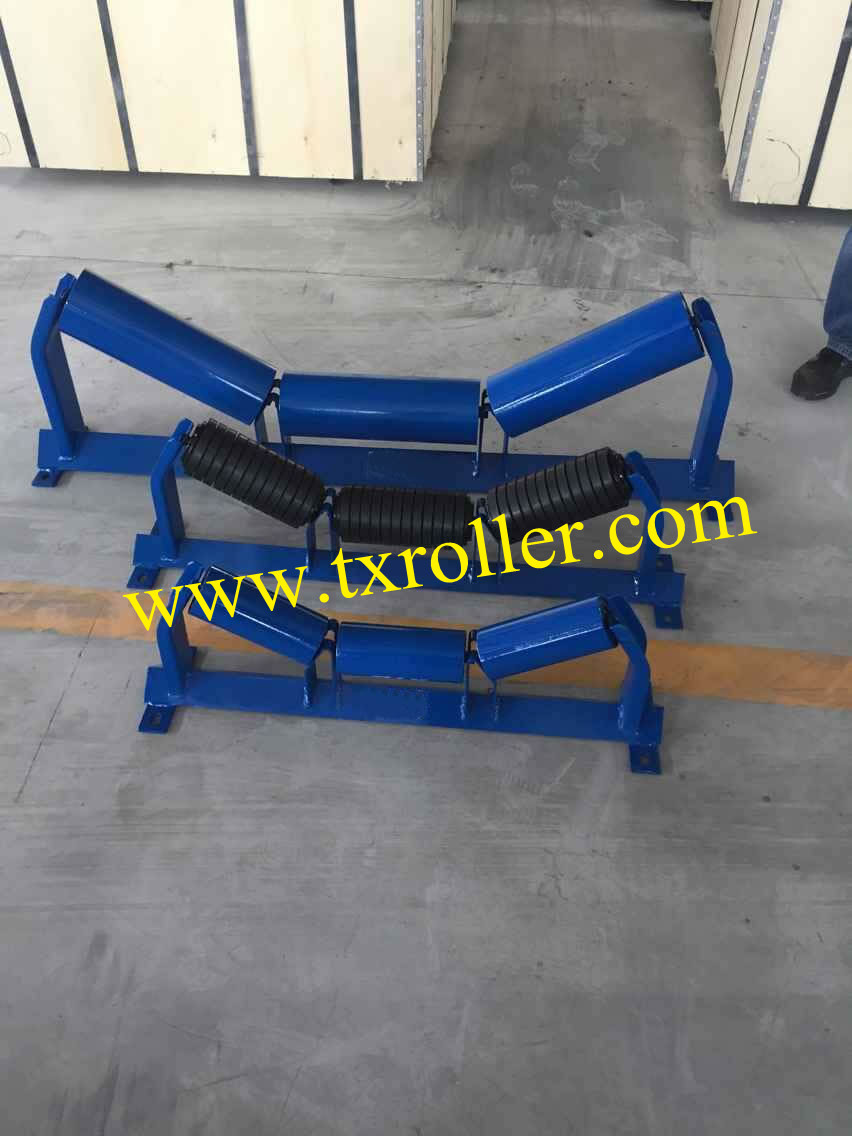
Trough Carrying roller:3 rollers+1 frame, it used for bulk material's transporting.The notes of trough roller:
1)to prevent the conveyor belt load start.
2)conveyor belt deviation, should take timely measures to correct.
3)different types, the number of layers of the conveyor belt should not be used together, the joint is best to use glue method.
4)the type of buffer roller, structure, specifications, layers should be based on the use of reasonable selection.
5)the drum conveyor drive roller diameter and the relationship between the conveyor belt, drive roller, hoist to the roller supporting the roller and the requirements of the roller should be based on the design of the transport aircraft, a reasonable selection.
6)the feeding direction should be along the conveyor belt running direction, in order to reduce the material falling on the impact of the conveyor belt should be chute, reduce the material gap; conveyor belt by the material should be shortened roller spacing and the use of buffer roller For the leakage of material, the conveyor belt to adapt to the use of soft moderate baffle board, so as not to file board too hard, scratch the conveyor belt with the surface.
Return roller role is to support the return of the belt, if the belt machine is shorter, you can use less. Standard General 1 m or 1.2 m put a back roller. In order to prevent long-term heavy load belt will sag, increase transport time, slow down, so place back roller to ease the belt loose. Some materials if there is adhesion, you can use the cleaning roller to clean the belt to prevent the material stick to the belt, if not cleaned, for a long time will cause damage to the belt, so the conveyor will be damaged.Criteria to determine the roller is good or bad the following criteria: Roll radial runout; roller flexibility; axial movement amount.
Return Roller or other rollers use and operation:
1) Roller should be carefully checked before use appearance of serious bump damage phenomenon, rotating roller should be flexible rotation, no jamming.
2) Roller installation distance should be depending on the type of logistics and conveyor characteristics of traffic volume determined by scientific calculations, to avoid too sparse or over-installed.
3) Roller installation should be adapted to avoid mutual wear and tear.